



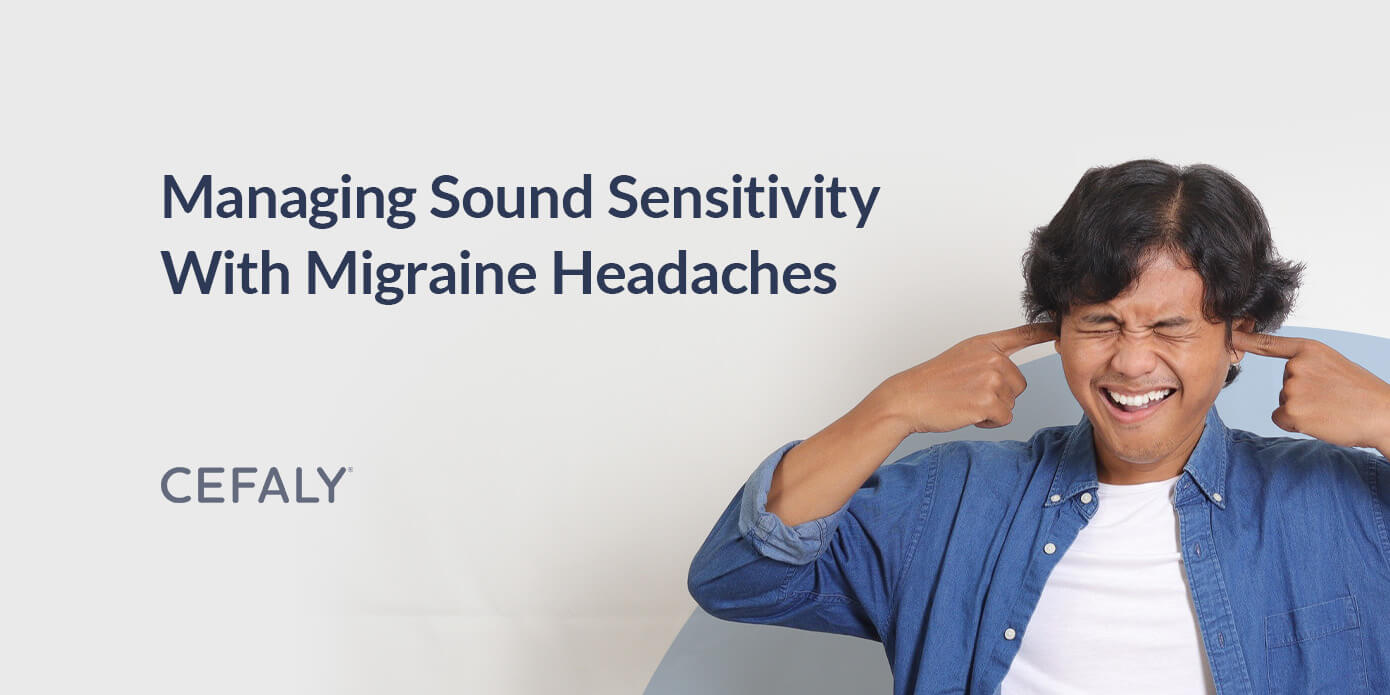
Managing Sound Sensitivity With Migraine Headaches
If you ever find that loud noises spark an intense migraine attack, you’re not alone. Many people struggle with sound sensitivity headaches, and sudden, loud noises are a common migraine trigger. You may also experience sensitivity right before or during a migraine attack.
Sound sensitivity migraine is hard to live with, but there are ways to make it more manageable. This guide outlines eight coping mechanisms and treatment options for noise-triggered migraine and auditory sensitivity. Some options — like CEFALY migraine devices — may even help reduce the frequency of migraine attacks so that you have more symptom-free days.
The prevalence of migraine noise sensitivity
Studies show that there is a high comorbidity — when two medical conditions occur together — between sound hypersensitivity and migraine. This condition is called phonophobia, which directly translates to the fear of sound. With migraine, phonophobia often refers to an aversion or sensitivity to sound rather than fear.
For people with migraine and phonophobia, loud noises — like shouting, car horns, construction work and fireworks — can trigger a migraine attack or make it worse. They may want to get away from the noise or turn it down. It’s also possible for people with migraine noise sensitivity to have hyperacusis. This hearing disorder makes normal, everyday noises seem unbearably loud and uncomfortable. Intense phonophobia may also accompany this disorder.



8 ways to manage sound sensitivity with migraine
If you frequently experience migraine attacks from loud noises, you may want to try various coping and treatment methods to see what works for you. Everyone’s experience with migraine is different, but the following options may help:
1. Use earplugs or headphones
Buying earplugs or headphones is a simple and effective method for handling migraine sound sensitivity. Carrying them with you wherever you go can help you dampen loud noises when they occur. Noise-canceling headphones or earplugs can completely block out all noise, which can be helpful when avoiding an attack or trying to get through one.
However, being unable to hear noises and people around you can be inconvenient, especially at work. Instead, look for earplugs that block out louder noises while allowing you to hear everything around you. These are especially useful at restaurants and events where you still want to listen to what’s going on.
2. Move things around
Another easy way to cope is by changing your environment to limit your proximity to loud noises. For example, consider moving your work desk away from a street-facing window or a loud copy machine. At home, move your bed to a room further away from communal spaces. If you can’t move your bed to a different part of the house, rearrange your bedroom so that your bed is on the wall farthest away from doors and windows.
3. Try a CEFALY migraine device
CEFALY is an FDA-cleared, drug-free treatment option for migraine. The device attaches to an electrode on your forehead to target the trigeminal nerve, the main pathway for migraine pain. It uses a form of neuromodulation therapy that sends gentle electrical currents to the nerve to calm and desensitize it.
During an attack, the device’s ACUTE mode can quickly relieve pain and other symptoms. It also has a PREVENT mode, which you can use daily to reduce the frequency of attacks. In one study, 56.4% of CEFALY users said the device resolved their most bothersome symptoms — including light or sound sensitivity.
Try CEFALY for Migraine Relief
4. Test exposure therapy
People who get painful sound-triggered migraine attacks sometimes develop worse phonophobia. This can cause intense fear of loud noises, as they often result in debilitating head pain and other migraine symptoms. If you feel anxiety or fear in anticipation of a loud noise and your heart rate spikes, you may want to try exposure therapy, a form of psychotherapy.
Exposure therapy — also called systematic desensitization — refers to the process of gradually exposing patients to their source of fear in a safe, controlled environment. For phonophobia, exposure therapy can involve listening to increasingly loud noises during each session with a therapist. The goal is to desensitize yourself and reduce your fear of loud sounds.
5. Listen to white noise
White noise is a sound that contains all frequencies, creating a static-like noise. This noise can irritate some people, but it’s a useful way to relieve headache noise sensitivity for others.
Playing white noise in the background can hide or reduce the intensity of other sounds, helping you focus and relax. You can also listen to binaural beats, which play different frequencies in each ear. The effect is almost meditative, which helps relieve tension and lower the intensity of migraine attacks.
6. Utilize sound-absorbing materials
Improving room acoustics helps reduce the chance of loud noises triggering your phonophobia migraine. Room acoustics refers to how sound reacts within a confined space. Hard surfaces in a room reflect more sound waves, causing noises to be louder and echoey.
To soften noises, you can add more sound-absorbing materials to the room. Soft, thick materials absorb sound waves, dampening the sound and reducing noise. Consider installing sound-absorbing foam panels on the walls, like those in music rooms. If these panels don’t fit your room’s design, add other soft materials like rugs, cushions and curtains.

7. Let others know
The people around you may be unaware that their activities are causing you pain. When possible, politely and calmly ask others to lower their volume around you. You can also ask them to work on noisy activities when you aren’t around. Be honest about how loud noises affect you.
8. Retreat to a quiet room
When a loud noise is bothering you, and you have nothing on hand to help, you may want to find a quiet room. It’s not always possible, but heading to a dark, safe space makes it easier to calm down and get through an attack.
At home, you can go to your bedroom and dim the lights. If you’re at work or in a public space, ask if there is a quiet room you can spend some time in. If you can, scope out new venues beforehand to look for a retreat in case of a migraine attack triggered by sound.
Relieve migraine pain with CEFALY
Did you know you don’t need a prescription to buy CEFALY? We have monthly payment plans available. Plus, thanks to our 90-day money-back guarantee, you can test it out and return the device if it doesn’t work for you.
What are you waiting for? Purchase a CEFALY device today to reclaim your life from migraine!






Latest Posts


“CEFALY Gave Me My Life Back”: Camille’s Search for a Drug-Free Migraine Treatment
Discouraged by her experience with medications, Camille began building a toolkit of non-pharmacologic migraine treatments. Find out what…

What Patients Need to Know About Episodic Migraine vs. Chronic Migraine
While official definitions classify episodic migraine as fewer than 15 headache days per month and chronic migraine as…