




Migraine Headaches and Disability Claims
Migraine is the leading cause of disability in adults under 50. It negatively impacts the lives of 90% of people who experience it. If you’re one of them, you know how attacks can put your productivity on hold for hours or days, leaving you anxious and frustrated.
In some cases, people with migraine may qualify for Social Security disability benefits. If you’re eligible, these benefits could help you offset migraine’s impact on your ability to work and live peacefully. This brief guide to migraine and disability benefits will help you understand whether you qualify and how to apply.
Does migraine qualify for disability?
The Social Security Administration (SSA) does not list migraine as a disability. However, migraine can qualify for disability benefits when you meet these criteria:
- 1. Decreased earning power: The amount you earn is lower than the substantial gainful activity threshold.
- 2. Medically determinable impacts: Medical examination verifies that migraine impacts your ability to work.
- 3. Medical equivalence: Your migraine’s impact is medically equivalent to an SSA-listed condition. A doctor can compare your symptoms to one of these conditions, like epilepsy. For example, migraine may force you to stay in a dark and quiet space to reduce the intense pain, which limits your physical and mental functioning.
Remember, the SSA provides benefits for long-term disabilities. Your migraine must be a chronic case lasting at least a year to qualify.
If your migraine case does not qualify, you may still be able to claim disability if your migraine headaches are a symptom of an SSA-listed condition, such as the following:
- High blood pressure
- Stroke
- Fibromyalgia
- Post-traumatic stress disorder
- Depression
- Heart disease
- Anxiety
- Epilepsy




Are you eligible to claim disability for chronic migraine?
To be eligible to claim disability for migraine, you must provide:
- An official medical diagnosis of your condition.
- Medical records from your doctor showing your migraine history, including physical exam reports, test results or prescriptions.
- A functional report explaining how migraine affects your ability to work.
These records and other evidence must persuade the SSA that:
- A medical professional has diagnosed you and eliminated other diagnoses through physical examination.
- Your doctor can describe your migraine episodes and accompanying symptoms in detail.
- Your migraine attacks continue despite attempted treatments.
- Migraine prevents you from getting a job or fulfilling your current job’s requirements.
- You are unable to get and succeed at other work.
- Your condition has lasted or will last at least a year.
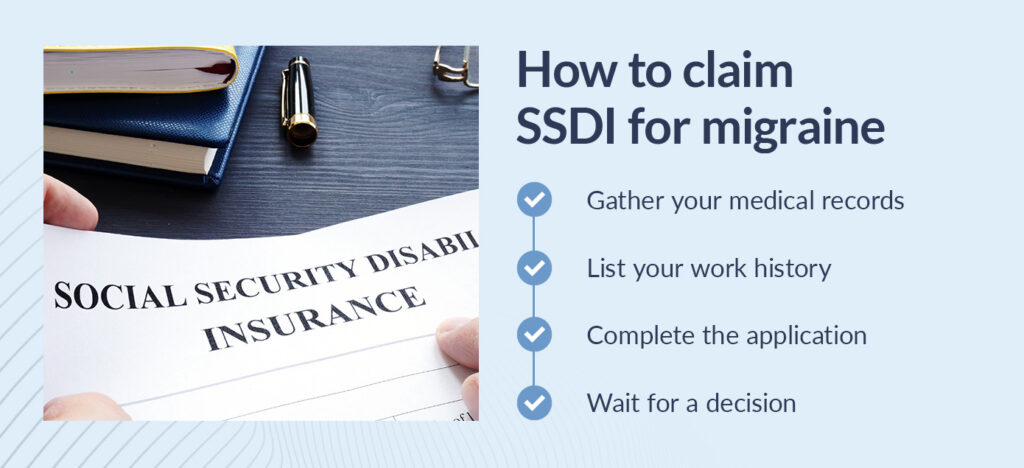
How to claim SSDI for migraine
If you meet the criteria, you can apply for Social Security Disability Insurance (SSDI) by following these four steps.
1. Gather your medical records
See the SSA’s starter kit for all the documents you need to apply. Start by gathering:
- Contact information of healthcare providers who have diagnosed or treated your migraine.
- Test result documents.
- A full list of your medications and who prescribed them.
- Descriptions of your symptoms and responses to treatments by healthcare professionals.
Let your doctor know that you want to apply for SSDI. They can help by writing reports that show migraine’s impact on your job-specific abilities. For example, if you work with computers, they can note that you can’t look at a screen for several hours during episodes. If your work involves physical labor, they can note that your migraine episodes affect your ability to safely operate machinery.
2. List your work history
The SSA’s starter kit also lists the work history documentation you need. This will include describing your education, training, job history and earnings. You must show that you have met the minimum work history requirements to qualify for SSDI funds.
3. Complete the application
You can apply for SSDI online through the SSA website. This allows you to skip the lines and appointments. You can also save your progress and resume your application later if you need to get more information or take a break. If you prefer, you can also apply in person at your local SSA office. The application will ask you for information like:
- Names and birth dates of dependents.
- Marriage dates, if applicable.
- A complete job and medical history report.
- Banking details to receive SSDI deposits.
4. Wait for a decision
After completing your application, the SSA will review your case and inform you of their decision via email or mail within a few months. You can also log in to their website to view your application status.
If they approve your application, you will receive financial benefits to help you cover your living expenses. Read all the terms, as there will be conditions you need to meet to continue receiving your benefits. For example, there may be an income limit you may not exceed while continuing to receive financial support.
What if your claim is denied?
Most SSDI claims — around 67% — are denied. However, if your initial application is denied, you could still be approved after one or more appeal stages:
- 1. Reconsideration: Make an initial appeal to the SSA for reconsideration. A new person will consider your application, including any documents you’ve added.
- 2. Administrative court: If denied again, ask for a hearing before an administrative judge. You may need to bring more documents or professional medical witnesses to support your claims.
- 3. Appeals council: If denied again, request a review by the appeals council. The appeals council may affirm the hearing’s conclusion or return your case for reconsideration.
- 4. Federal court: If denied again, you may file a federal district court lawsuit.
You’ll need to make your initial appeal within 60 days of receiving the notification that your application was denied. Many who eventually get SSDI only succeed after a court hearing, so take heart and prepare yourself for the process. The letter stating that your initial application was denied will often mention a reason, such as a document you left out. It will also include instructions on beginning the appeal process. Follow these guidelines and aim to address the SSA’s stated concerns by supplying any missing information when you appeal.
Experience migraine relief with CEFALY
If your application is successful, SSDI will provide some financial relief. Whatever the final result, what you might want most is relief from your migraine episodes. For a migraine treatment that’s clinically proven to relieve pain, try CEFALY.
CEFALY is an FDA-cleared, easy-to-use migraine treatment device with two modes — PREVENT and ACUTE — to reduce migraine frequency and relieve symptoms. Clinical research shows that 79% of acute migraine sufferers in one study experienced relief with CEFALY.
On a tight budget? We do our best to make CEFALY affordable and accessible to all. You can buy CEFALY and electrodes with your HSA/FSA dollars: It’s an eligible medical expense for health savings accounts (HSAs) and flexible spending accounts (FSAs). Or, you can pay over time with Affirm or PayPal Credit.
Try CEFALY for 90 days with our money-back guarantee.






Latest Posts


“CEFALY Gave Me My Life Back”: Camille’s Search for a Drug-Free Migraine Treatment
Discouraged by her experience with medications, Camille began building a toolkit of non-pharmacologic migraine treatments. Find out what…

What Patients Need to Know About Episodic Migraine vs. Chronic Migraine
While official definitions classify episodic migraine as fewer than 15 headache days per month and chronic migraine as…