




VA Disability Ratings for Migraine
From 2008 to 2019, more than half a million veterans were diagnosed with migraine. If you are experiencing severe migraine attacks after your military service, you may be able to receive benefits from the United States Department of Veterans Affairs (VA). To do so, you’ll have to demonstrate that the attacks are linked to your service or have increased in severity due to your experiences during service.
What are VA ratings for migraine?
VA disability ratings are covered in the VA Schedule for Rating Disabilities, with migraine categorized under Diagnostic Code 8100.
VA migraine ratings help determine whether you are eligible for disability benefits and, if so, how much you receive. The ratings consider how often you experience migraine attacks, how intense the attacks are and how long they last. Here’s a quick breakdown of the VA’s rating system:
| Rating | Critera |
| 50% | Attacks are frequent and prostrating and result in severe economic inadaptability. |
| 30% | Characteristic prostrating attacks occur once per month on average over the last several months. |
| 10% | Characteristic prostrating attacks occur once every two months over the last several months. |
| 0% | Attacks are less frequent. |
Monthly compensation is highest for migraine rated at 50%.
“Prostrating” refers to severe migraine attacks that cause extreme exhaustion, weakness and pain. If you experience these attacks, you may only find relief by lying down in a dark and quiet room. “Severe economic inadaptability” means the attacks impact your ability to work and earn money.
Who qualifies for disability benefits from the VA?
While some exceptions exist, most veterans seeking disability benefits must have received an honorable discharge or been discharged under honorable conditions. Veterans seeking migraine-related benefits must link their attacks to their service. For example, you may qualify if:
- You began experiencing migraine after your service and can show a link between the two.
- Your military service worsened the migraine attacks you experienced before joining the military.
- You got sick or injured during service and can connect your migraine attacks to that illness or injury.
Other relevant criteria
You can also get disability coverage if your migraine developed as a by-product of another condition, such as tinnitus or a traumatic brain injury. These conditions have a separate rating, and the VA combines ratings to determine an overall score.
If your service-related migraine stops you from getting substantially gainful employment, you may qualify for Total Disability Individual Unemployability (TDIU). In this instance, you can receive compensation at the same level as a veteran with a 100% disability rating. To qualify, one of the following must be true:
- You have one service-related disability rated at 60% or higher.
- You have at least two service disabilities, with at least one rated at 40% or higher and a combined rating of 70% or more.
Calculating your combined disability rating is slightly more complicated than adding the individual ratings together. You can check out the VA’s disability rating calculator and combined rating table for more information. As a quick example, a veteran with a migraine VA rating of 50% and whose post-traumatic stress disorder is rated at 30% would have a combined rating of 70% and could qualify for TDIU.
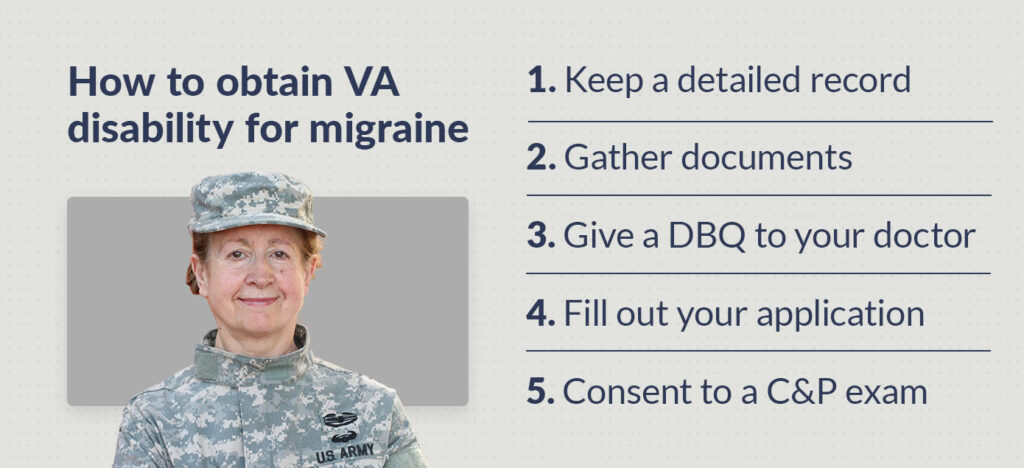
How to obtain VA disability for migraine
To qualify for VA disability benefits for your migraine, follow these steps:
1. Keep a detailed record: Use a migraine journal or management app to keep track of your migraine attacks, including dates, times, symptoms and whether it forced you to miss work.
2. Gather documents: Military incident reports can help verify that your migraine attacks result from a specific incident. Medical evidence, such as a letter of medical necessity, a diagnostic report or a nexus letter, is also beneficial. You might also include supporting statements from friends, family members or people you served with.
3. Give a DBQ to your doctor: While not required for getting coverage, the VA Disability Benefits Questionnaire (DBQ) allows your healthcare provider to support your experience and speed up the process.
4. Fill out your application: You can fill out VA Form 21-526EZ online or print it out and mail it to the VA Evidence Intake Center. You can also bring your filled-in form to a VA regional office.
5. Consent to a C&P exam: While not always necessary, a compensation and pension (C&P) exam is sometimes required if the VA needs more information to decide your claim.
From there, all that’s left is to wait for the VA’s decision.
What to do if the VA denies your initial disability claim for migraine
You can appeal the VA’s decision if they deny the service connection or if you seek a higher disability rating for migraine. You have three options to continue your case:
- Supplemental claim: A supplemental claim allows you to submit new and relevant evidence. It is also a good option if the law changes and you want your case to be reviewed again.
- Higher-level review: A review by a higher-level reviewer can determine if the initial reviewer made an error. The higher-level reviewer may also have a different opinion that changes the original result.
- Board appeal: With this option, a judge who is an expert in veterans law will review your case at the Board of Veterans’ Appeals in Washington, D.C.
If you try one option and still aren’t satisfied, try another. You can also request a clinical appeal if you disagree with a VA medical decision regarding your migraine treatment or care.
How CEFALY helps veterans
Whether you receive VA disability benefits or have standard VA coverage, you can explore treatment methods to alleviate migraine pain and reduce your attacks. CEFALY is an FDA-cleared migraine treatment device that provides drug-free relief. The device connects to an adhesive electrode on your forehead and targets the trigeminal nerve to prevent episodes and relieve pain.
CEFALY is 100% covered by VA healthcare benefits. To receive your CEFALY device from the VA, make an appointment with your VA healthcare provider or neurologist to express your interest in the device. Once the VA sends the purchase order to CEFALY Technology, we’ll ship your kit! Then, you can schedule a free session with a CEFALY Coach for tips and guidance on your new device.







Latest Posts


“CEFALY Gave Me My Life Back”: Camille’s Search for a Drug-Free Migraine Treatment
Discouraged by her experience with medications, Camille began building a toolkit of non-pharmacologic migraine treatments. Find out what…

What Patients Need to Know About Episodic Migraine vs. Chronic Migraine
While official definitions classify episodic migraine as fewer than 15 headache days per month and chronic migraine as…