



Explore the Connection: Migraine, Infertility, and Depression
Infertility is so, so hard.
It sends you on a roller coaster of hope, frustration, and grief. It takes a toll on your relationship, your body, and your finances. And it can be even harder when you’re already living with a chronic condition, such as migraine, depression, or both.
Worldwide, gynecological disorders (which can cause infertility), headache disorders, and depressive disorders are the top three most common causes of disability for women aged 15-49. If you have all three, you may say, “Why me?!?”
Just remember that you are not alone. We’ll walk with you through a brief summary of what we know about migraine, infertility, and depression.
Is there a connection between migraine and infertility?
Doctors don’t believe there’s a cause-effect relationship between migraine and infertility. In other words, having migraine doesn’t cause any physical changes in your body that would stop you from conceiving.
However! If you live with migraine, you know that it’s a complicated disorder that affects many — or even all — aspects of your life. So there are a few ways that migraine may be linked to infertility.
- Stress: Stress is the number-one most common migraine trigger, as you probably know. Not only that, but the pain and frustration of migraine causes a lot of stress in your life. People with chronic migraine (headaches on 15 or more days every month) are especially likely to have high stress levels.
Being stressed can make it harder to get pregnant: Stress hormones disrupt communication between the brain and the ovaries, affecting ovulation. Infertility itself causes a lot of stress, too: emotional stress, financial stress, relationship stress.
- Hormonal shifts: Another common migraine trigger is hormones associated with the menstrual cycle. If you experience migraine attacks around the time of ovulation, sex is the last thing on your mind. This may cause you to miss your fertility window.
- Infertility treatments: If you’re undergoing infertility treatments such as IVF that alter your body’s hormones, that’s a possible migraine trigger. One study noted that women with migraine seem to experience greater headache frequency as they go through IVF or egg/embryo freezing, although more research needs to be done.
- Co-occurring conditions: Research has found that women with endometriosis (a condition in which tissue similar to uterine tissue grows outside the uterus) and polycystic ovarian syndrome (PCOS) are more likely to have migraine. These conditions can affect fertility.
- Relationship problems: It’s common for migraine to strain a marriage or relationship. Infertility, too, can drive a wedge between partners. If you and your partner are struggling to connect with each other emotionally, conceiving becomes even more challenging.
- Delaying pregnancy: Migraine pain and fear of ceasing their migraine medication may lead some women to delay pregnancy. In one small survey by the American Registry for Migraine Research, 20% of women surveyed said they had avoided pregnancy because of migraine. They believed that their migraine symptoms would be worse during pregnancy, that migraine symptoms would make pregnancy difficult, and that migraine medications they take would affect their child’s development. A few women also believed that migraine would cause their baby to have birth abnormalities. (Fact check: Migraine in a mother does not affect your child’s development.)
Waiting to conceive can affect your chances of a successful pregnancy, because fertility typically begins to decline by age 30. Talk to your doctor about how to manage migraine during pregnancy and how to taper off any potentially harmful medications.




How does depression intersect with migraine and infertility?
Migraine, depression and anxiety are commonly experienced together. People with migraine are two to five times more likely to have one or both of these conditions, compared to people without migraine. Doctors believe it’s a bidirectional relationship. That means having migraine may cause depression, and having depression can lead to migraine.
The stress, stigma, and sadness of infertility can also result in depression. Between 25 and 60% of people with infertility also experience depression, according to various studies.
Struggling with depression and don’t know where to find help? In the U.S., contact SAMHSA’s National Helpline for individuals and family members facing mental and/or substance use disorders. The helpline will give you referrals to local treatment facilities, support groups, and community-based organizations.
- Call 1-800-662-HELP (4357)
- TTY: 1-800-487-4889
- Text your ZIP code to 435748 (HELP4U)
- Visit the online treatment locator
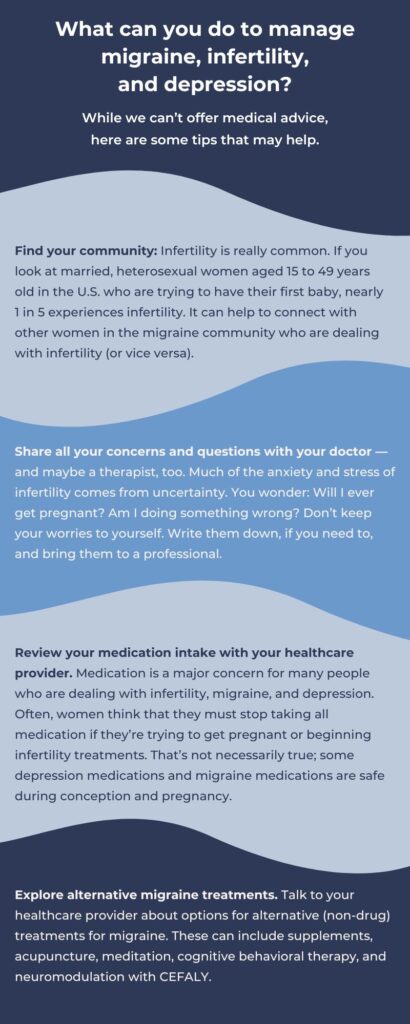
| Can You Use CEFALY While Pregnant? ✓ CEFALY can be a safe and effective drug-free migraine treatment during pregnancy. ✓ Many women have used CEFALY for migraine relief during pregnancy with no known serious adverse effects. ✓ The safety and efficacy of CEFALY have not been evaluated in pregnant women. ✓ Ask your doctor before using CEFALY if you are pregnant or may become pregnant. Learn more about CEFALY, migraine and pregnancy |
Curious about CEFALY? Try our innovative migraine prevention and pain relief in your home for up to 90 days risk free!





Latest Posts


“CEFALY Gave Me My Life Back”: Camille’s Search for a Drug-Free Migraine Treatment
Discouraged by her experience with medications, Camille began building a toolkit of non-pharmacologic migraine treatments. Find out what…

What Patients Need to Know About Episodic Migraine vs. Chronic Migraine
While official definitions classify episodic migraine as fewer than 15 headache days per month and chronic migraine as…